Grandpa George
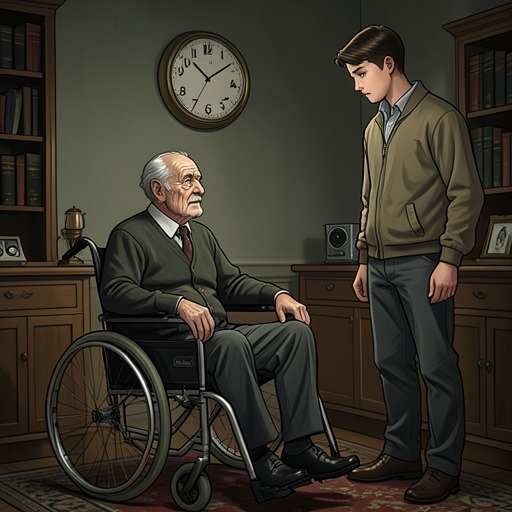
Charlie and the Chocolate FactoryGrandpa George is Charlie Bucket’s maternal grandfather and one of the four elderly relatives whose presence defines the crowded, impoverished Bucket household. He is the father of Mrs Bucket and lives with her, Mr Bucket, Charlie, Grandpa Joe, Grandma Josephine, and Grandma Georgina in a small wooden house on the edge of a great town. Although he is not the family member who accompanies Charlie into Wonka’s Chocolate Factory, Grandpa George helps establish the social and economic world from which Charlie’s extraordinary opportunity emerges: a world where affection is abundant but money, space, food, and physical comfort are severely limited.
Identity and Place in the Bucket Household
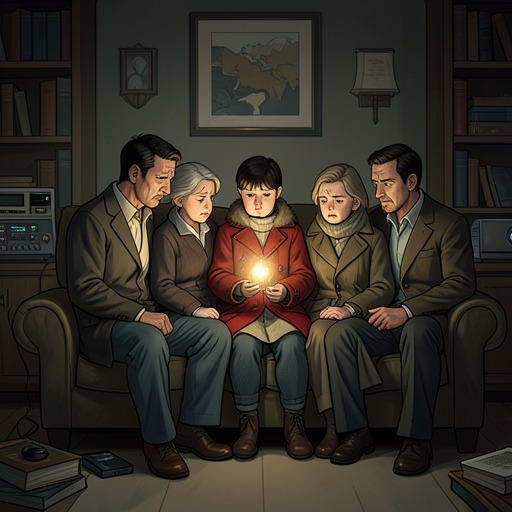
Grandpa George shares the only bed in the house with the other three grandparents. The arrangement is a practical response to age and exhaustion: the four old grandparents are considered too old and tired to get out of bed, while Mr Bucket, Mrs Bucket, and Charlie sleep on mattresses on the floor in the other room. The two-room house is far too small for seven people, and winter draughts sweep across the floor at night. The family cannot afford either a better home or even a second bed, so Grandpa George’s identity is inseparable from the household’s material deprivation.
That poverty is not presented as a temporary inconvenience. Mr Bucket is the only family member with a job, and his work consists of screwing caps onto toothpaste tubes for very little pay. The family survives on bread and margarine, boiled potatoes and cabbage, and cabbage soup; Sundays bring the small privilege of a second helping. Grandpa George therefore belongs to a family that does not starve, but that lives constantly with hunger. His perspective on Charlie’s prospects in the Golden Ticket contest is grounded in this reality rather than in wishful thinking.
Response to Willy Wonka and the Golden Ticket Contest
When the family discusses Wonka’s Chocolate Factory, Grandpa George joins the older generation in affirming its astonishing scale. The grandparents insist that the factory is about fifty times as large as any other, and the family treats Willy Wonka as the most extraordinary chocolate maker in the world. These conversations make the grandparents’ bed a temporary refuge from hunger and poverty: for a short time each evening, stories about the factory transform the room into a happier place.
The announcement of the Golden Ticket contest intensifies that imaginative escape. Willy Wonka offers five children a personal tour of his factory, access to its secrets and magic, and enough chocolates and sweets to last for the rest of their lives. Grandpa George responds by puncturing the fantasy with an economic calculation. When Charlie says that there is no hope because he receives only one chocolate bar a year, Grandma Georgina tries to encourage him by saying that his birthday is approaching and that he has as much chance as anyone else. Grandpa George rejects that comforting claim: the children who find tickets will be those who can afford to buy chocolate bars every day, whereas Charlie gets only one a year.
His conclusion is pessimistic, but it is not cruel. Grandpa George understands that the contest is formally open to children everywhere while being materially easier for children from wealthy families to enter repeatedly. The contrast between a worldwide search and Charlie’s single annual bar exposes the unequal economic conditions beneath the contest’s language of luck. In this respect, Grandpa George functions as the household’s blunt social observer: he sees that chance is shaped by purchasing power.
Wealth, Consumption, and Veruca Salt
The discovery of the second Golden Ticket by Veruca Salt confirms Grandpa George’s suspicion. Veruca’s father explains that he bought thousands, perhaps hundreds of thousands, of Wonka bars and redirected the workers in his peanut business from shelling peanuts to removing chocolate-bar wrappers. The search continued from morning until night until one worker found the ticket on the fourth day.
Grandpa George’s earlier assessment is thus set against the Salt family’s vast resources. Charlie’s family cannot afford another chocolate bar, while Mr Salt can mobilize an entire workforce and industrial supply of chocolate in order to satisfy his daughter’s demand. The contrast is sharpened by Veruca’s parents’ response to her distress: when she screams and kicks because she wants a Golden Ticket, her father vows to continue until he obtains one. The ticket is not merely found; it is purchased through wealth, labor, and parental submission.
Grandpa George’s household reacts with open disapproval to the public celebration of Augustus Gloop and the Salt family. After hearing Augustus’s mother justify his excessive chocolate eating as a form of nourishment, the grandparents call both mother and son revolting and repulsive. Grandpa George’s judgment places the family’s hunger beside the other children’s destructive abundance. He does not treat unlimited access to chocolate as an uncomplicated blessing; the behavior surrounding it reveals gluttony, entitlement, and the power of adults to turn money into children’s apparent success.
Charlie’s Ticket and the Family’s Reversal
Grandpa George’s pessimism is overturned when Charlie finds the fifth Golden Ticket. Charlie returns home after finding money in the street, buying two chocolate bars, and discovering the ticket in the second bar. He rushes into the grandparents’ room and announces that it is his, while Mrs Bucket and all four grandparents freeze in astonishment and drop their spoons. The moment produces absolute silence before the family can accept what has happened.
The reversal does not erase the poverty Grandpa George identified. Charlie has not suddenly become a child who can buy chocolate every day; he has succeeded through an improbable combination of found money, a rare purchase, and chance. That distinction gives the discovery its force. The contest’s apparent rule is that anyone may win, but Grandpa George has shown why the distribution of opportunity makes such a victory almost unreachable for Charlie. Charlie’s ticket becomes a dramatic exception to the economic pattern rather than evidence that the pattern never existed.
The timing makes the reversal especially urgent. The factory visit is scheduled for the first day of February, and Charlie’s family realizes that this is the following day, the last day of January being nearly over. Grandpa Joe immediately urges Charlie to prepare by washing his face, combing his hair, scrubbing his hands, brushing his teeth, cutting his nails, polishing his shoes, ironing his shirt, and removing the mud from his trousers. Grandpa George is present as part of the stunned family whose ordinary evening has been converted into preparation for the biggest day of Charlie’s life.
The Factory Visit and Narrative Significance
Outside Wonka’s Chocolate Factory, enormous crowds gather to watch the five ticket holders enter. The police shield the children and accompanying adults from the pushing, shouting crowd, and Grandpa George’s son-in-law, Mr Bucket, and daughter, Mrs Bucket, are part of the family world surrounding Charlie even though Grandpa Joe ultimately goes inside with him. Charlie stands beside Grandpa Joe and holds his hand tightly; the other children arrive with both parents, while Charlie is the only child not accompanied by both mother and father.
Grandpa George’s narrative importance lies less in action than in the moral and social perspective he supplies. He belongs to the generation that sees the family’s poverty directly, measures the Golden Ticket against the cost of a chocolate bar, and recognizes the difference between genuine luck and wealth-backed access. His skepticism makes Charlie’s success meaningful, while his presence in the family’s astonished reaction shows that the ticket is not an individual triumph alone. It is a transformation in the fortunes of an entire household.
That transformation reaches its largest possible consequence when Willy Wonka explains that he intends to give the factory to Charlie. Wonka says that he has no children or family of his own, cannot run the factory forever, and wants a good, sensible, loving child rather than a grown-up who would refuse to learn his ways. Grandpa George is among those who must confront the astonishing scale of the offer. The factory, first imagined by the grandparents as a distant marvel and a source of endless chocolate, becomes a possible inheritance for Charlie. Grandpa George’s earlier insistence that there was no hope is therefore answered not by a gradual improvement in the family’s circumstances, but by a sudden passage from hunger and cramped mattresses to the prospect of Charlie inheriting Wonka’s entire world.